Grok made a lux chocolate cake made of butter & cashew nut for me.
Yes. I am celebrating another birthday today. Mine. I'm grateful to have had so many that I'm beginning to forget the numbers. At this stage of my life, it seems to me that apart from birthdays, I'm trying to keep up with Christmas, followed by Gregorian New Year, then Chinese New Year with birthdays to be endured in between let alone celebrated. That's mainly because birthdays are more personal hence a solitary venture seen as a minor inconvenience by many. Unless you have family close by.
But then I've always subscribed to the adage; 'Age is nothing but a number.' And you get to pick it. Nobody cares.
So I shall conveniently forget my age. If anybody must really know it's pegged at 58. That's half a lie of course but since the concept of age is already one big lie, we might as well joyfully participate in this illusion. 58 is my birth year.
Birthdays come and go. The more we have them the longer we live. I highly recommend them.
However, as long as I still have birthdays, I will hold fast to the words my mother often times tell me;
"As long as we're happy, everyday can be our birthday." - Abu
I have gifts.
With Birthdays, traditionally come gifts. And gifts are quite another kettle of fish altogether.
It has been said that it is nobler to give than to receive. I cannot find fault in that saying. Neither do I intend to find fault with the giver given that it's the thought that counts when it comes to gifting.
However I also think that being on the receiving end is a much nobler privilege as the receiver gets to truly discover who truly are the people that truly put thought into acquiring a present for us or even know us. Deeply and intimately.
I have received a few gifts in my life and there are many delightful gifts that are too many to recall but I believe that best test for the longevity, durability hence the likability of the gifts I received is the measure of the gifts I still have around me, in my possession, such that I get to see them and be near them, enjoy them, admire or use them.
I scan the living room, bedroom, guest room, kitchen, storeroom and I see the most significant gifts I have received and kept have all appealed to my innermost self beyond self. They have been painstakingly picked or made by only one person whom I admire, respect, cherish, treasure and love. The person who has spent over 3 decades taking care of me and gifting me with treasures I never dreamt possible. Best of all: our three wonderful children. I have all these great treasures for as long as I live.
The person about whom I used to lament at the illusion that she doesn't know me at all.
How wrong I was. How lost and delusional I was.
But I know now. I know now.
I hope she knows that I know.
And that I'm remembering her on my birthday.
And if birthdays are about gifts I want her to know she has already given me the best gifts I have ever wanted.
The Qingming Festival by the Riverside, is a long, painted scroll 528 cm long and 24.8 cm wide, which portrays street scenes of Bianjing (today's Kaifeng City, Henan Province), the capital of the Northern Song Dynasty (960-1127).The work was created by Zhang Zeduan, a native of Shandong Province who studied painting in his early years in Bianjing.
It was fun from the very onset when Kelvin picked me up, 'chauffeur-driving' his parents sitting like The King & Queen at the backseat of his pickup truck. I gave a big hug to big brother Johnny seated at the back looking cool in sunglasses, framing a red and healthy face.
“He’s skinny isn’t he?” said Karen looking radiantly happy & concerned at the same time.
"He looks healthy" I said, and climbed into the front passenger seat and gave Kelvin a hearty handshake having not seen him for over a year. I was dying to catch up with this awesome nephew of mine. And we have the entire road trip to share & catch up with everyone.
Traffic going south on the PLUS highway was unusually heavy for a Sunday afternoon.
Thankfully I had Kelvin to keep me entertained with his travel stories in the West. Johnny & Karen were as quiet a snoring mice. With intermittent rain, traffic got a lot lighter after Seremban and we reached Woon Estate just before 6pm. We were warmly welcomed by an anxious and impatient nephew in the form of Danny who was either very happy or very hungry.
Being the filial and responsible nephew, Danny was visibly happy to see us and promptly ushered us to the dinner table, where a feast was laid out that looked like a CNY reunion dinner spread. How fitting it was as neither of us have spent a CNY reunion together for way too long. This was exactly May Sia’s sentiments. She has taken some pains to cook us our favourites-stewed pork leg, chicken curry, sambal petai, an assortment of sautéed green vegetables & legumes (mysteriously missing were sauteed cabbage) topped off with two-types of rice- white or purple yam. Yummy to both!
When Darren, Danny’s son arrived with girlfriend Emily, everyone was forced to sit and dig into dinner even though it was only just past 6pm. Who eats dinner at 6pm? I thought. Perhaps rednecks Chinese? Yup that would be us! Middle class workers, farmers/landowners. With a touch of baba/nyonya aristocracy
Everyone enjoyed the delicious dinner accompanied by a bowl of black bean pork ribs soup each. Johnny especially had a good time & a big appetite shovelling food into his frail frame. I had one helping of yam rice and two helpings of white rice enjoyed leisurely. It was a lovely familial communion over traditional family fare cooked with love. Thank you May Sia. Dessert came in the form of very sweet passion fruit like no other we have tasted. Danny claims it’s from his farm. It’s really sweet. We sat chatting way past dinner.
The time is 10.40pm. Some people are hungry again. Everyone leaves for town to have supper of roti canai, satay and teh tarek except me, I was too stuffed so I sit out to enjoy the solitude of the town I was born in and the hood I was raised in till I left home. It felt exactly like how it was when I was a teenager growing up. It’s been over half a century yet the environment is still, quiet, serene and peaceful. The gentle breeze & fresh air felt comforting. This is home. I felt good. At peace.
Then the food horde returned and went straight to bed. Danny & I sat chatting & listening to music till late under the newly renovated high-ceiling patio that looked like a spacious dining hall cum living room. Raising the roof really does raise the ceiling and the standard of living. It improves air flow, encourages upward glances and contemplation.
Monday morning. Most of us were up just after 7am to be greeted by Johnny’s deep chattering voice and a morning downpour. We sat chatting over coffee while waiting for the rain to clear so we could enjoy a hearty Tampin breakfast promised by Danny. As the rain subsided, we were brought to Mani’s place, an Indian restaurant on a side street behind the big market. All six of us ate to our hearts content, notably Johnny who ordered & ate everything up. Mani does serve very good Indian breakfast or even lunch. The bill was RM37 happily paid by Danny who said he saved spending more had we gone to the fishball laksa originally planned. With the rain down to a drizzle, we set out for Johol for tomb sweeping. Just the 3 of us. An uncle-me and two nephews-Kelvin & Danny. As we drove off, the stock market had just opened, being a Monday following Trump’s Liberation Day on April 2. Danny lamented on the quickly crashing stock markets while fulfilling orders from his clients on his mobile device conducting business as usual in his truck. He turned to us smiling as he announced he had already recouped the cost of our breakfast.
It was drizzling as we arrived at the foot of the cemetery. The fitter and younger men reached Papa & Abu’s grave effortlessly while Danny huffed & puffed his way slowly up the steep hill.
Since it rained all night, coupled with the fact that we missed last year’s Ching Meng, there was quite a lot of debris to clear which was, with some effort executed by 3 able-bodied men. The big tree under which our parents rested has grown even bigger spreading her canopy over a wider area of the grave providing us a natural cover from the rain. It was a picturesque setting atop the hill, worthy of a Chinese painting.
After clearing most of the debris we performed the rituals and prayers with all the necessary paraphernalia including counterfeit US currency, to the latest iphones. After burning the offerings, candles & joss sticks we sat with our parents for a while admiring their clear and unblemished faces adorning the tombstone, smiling back at us while a troop of monkeys foraged in nearby trees. This spot hasn’t changed much in almost 40 years. The view of the green valley below remains unspoilt. This is good Feng Shui I surmised. Looking around at graves populating the hill, a popular saying comes to mind; ‘You can take a Chinese out of China but you can’t take China out of the Chinese.’ Against the backdrop of the current economic crisis, China seems to be at the center of it.
On the way back we paid a visit to our crumbling ancestral home built by grandfather Gan Swee in 1919, then the Kapitan China of Johol during her glory days. We entered the house to retrieve a few books and files from my last residence here during Covid, minding our startup herbal farm for over 2 years. Our second uncle’s youngest son, Ah Chai, has taken abode here and is currently caretaker. He looks well fed & healthy. Said a brief hello and a quick goodbye to our young cousin and left, hoping to return again soon.
We got back to Woon Estate by early afternoon, cleaned up, packed up and left for lunch in Tampin town. Danny promised us the best fried chicken in town situated near Ambank. We arrived to find it closed on Mondays. We unanimously agreed to opt for Long Kang Mee. It was closed as well.
So we finally settled for a nearby coffee shop called Tampin Rojak housing a variety of local food stalls which we enjoyed including the rojak. We promptly left after 2pm as Kelvin had an appointment to keep back in KL.
We said our goodbyes to the best host and hostess in Tampin promising to return with a vengeance.
Overall the entire 24-hour trip was a long awaited and thoroughly enjoyable one, once again reminding me that family reunions with the living or dead give meaning and purpose to life.
Picture a shy, scruffy mathematician with a mind like a lightning bolt. In the dark days of World War II, when Nazi submarines were choking the Allies with unbreakable coded messages, Turing became the hero no one expected.
Bletchley Park Mansion.
At a secret British base called Bletchley Park, he invented the Bombe—a clanking, whirring machine that smashed through the Nazis’ Enigma code. This wasn’t just a gadget; it was a game-changer.
The Bombe Machine
The Bombe
Bombe model at Bletchley Park
Thousands of operators at Bletchley Park
By cracking the code, Turing revealed enemy plans—where their U-boats lurked, when they’d strike—saving countless ships and lives. Some say his work shaved years off the war.
Why does he matter? Because this quiet genius didn’t just beat the Nazis; he showed the world what human brilliance could do against impossible odds.
Today, every time you use a computer, you’re touching his legacy—he’s the guy who started it all.
Part 2 - The Boy Who Loved Numbers
Alan aged 15 at Sherborne.
He’s the kid who turned numbers into magic. Born in 1912 in London, little Alan was a shy, dreamy boy who didn’t fit in—except with math. While other kids played tag, he’d sit under a tree, scribbling equations, his eyes lighting up at puzzles no one else could solve. By his teens, he was cracking problems that stumped grown-ups, his brain buzzing with ideas too big for his time.
Why does he matter? Because that curious kid grew up to invent computers and break Nazi codes, all starting from a love of numbers that wouldn’t quit.
Turing’s story proves the quiet dreamer can change the world—one equation at a time.
Part 3- Inventing The Computer
Image generated with Ai for Turing
He’s the visionary who gave us computers—and made them think. In the 1930s, Turing dreamed up the “universal machine,” a device that could solve any problem with the right instructions, laying the groundwork for every computer we use today. But he didn’t stop there. Later, he cooked up The Turing Test aka the “Imitation Game”*—a test to see if a machine could chat so cleverly you’d mistake it for a human.
Why does he matter? Because Turing didn’t just build the future; he asked if it could outsmart us.
From laptops to AI, his ideas still run our world—and keep us guessing.
Part 4 - Facing A Cruel World
Image generated with Ai.
He’s the genius who saved millions, then got crushed by cruelty. After cracking Nazi codes in World War II, Turing should’ve been a hero. Instead, in 1952, Britain turned on him. Why? Because he was gay, and back then, that was a crime. The man who’d outsmarted Hitler was arrested, humiliated, and forced into chemical castration—hormone injections that wrecked his body and spirit.
Why does he matter? Because even when the world betrayed him, Turing’s brilliance endured. His story isn’t just about computers; it’s a gut-punch reminder of how society can fail its greatest minds—and why we fight to make it right today.
Part 5 - A Mysterious End
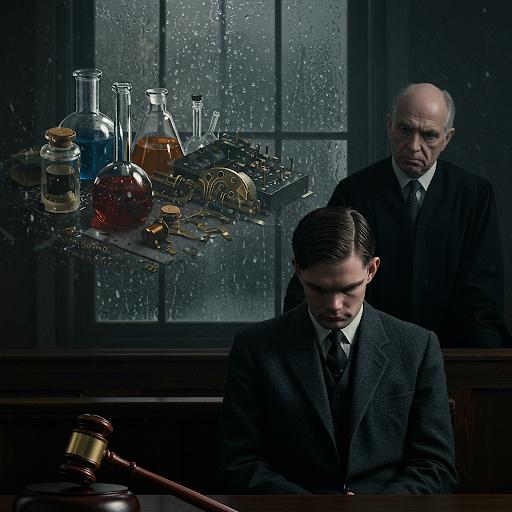
Image generated with Ai
He’s the mastermind whose life ended in a riddle. In 1954, at just 41, Turing— the guy who broke Nazi codes and birthed computers—was found dead in his home, an apple laced with cyanide beside him. Suicide? Accident? Murder? No one knows. The world lost a giant, his final chapter as puzzling as the codes he cracked.
Why does he matter? Because even in death, Turing left us wondering—his mind so brilliant, his exit so haunting and how he chose to endure the pain of hormone therapy over a two-year jail sentence.
Today, every click on your keyboard echoes his genius, a legacy too big to fade.
P/s. Perhaps now you, like me, will finally begin to appreciate the movie I saw years ago but never truly understood the gravity of the story until we arrived at our ChatGPT moment.
Have you found meaning in your life or have you found your purpose?
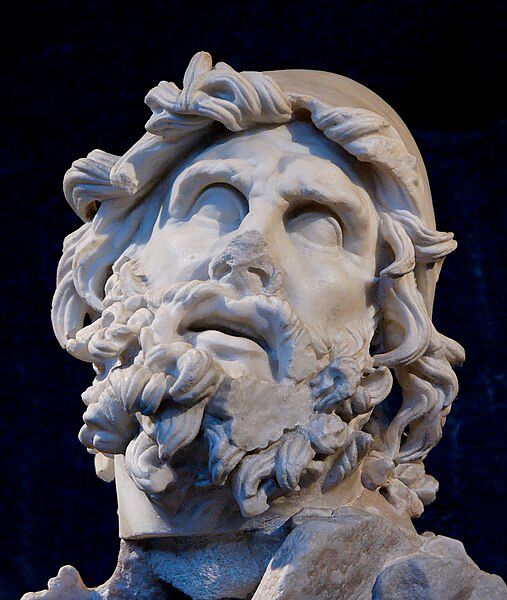
Head of Odysseus-Marble, Greek, Ca.1st Century AD-Sperlonga.
Let me extrapolate my questions. There are seemingly two parts to the question.
First, on the meaning of life. Have you figured out what is the meaning of life or simply question the meaning life holds for us? Why are we here?
Having being flung onto this Earth was a rude awakening from wherever we came.
We suddenly find ourselves living among people we first call our parents, then our grandparents, our relatives, then our siblings, our friends, our close friends, our love interests, our soul mate/s and if we are so blessed, children and grandchildren. All this happens while we pursue an education, a career, a vocation - a life. And then, we die. Is that it?
Second, on the purpose of life. Have you found your purpose in life? What is it that we are supposed to do in this life? Who is watching? Who is keeping score? Who is it that says we have achieved our life's purpose and can therefore move on to the next level?
These are fundamental questions no less deep.
But these questions have prevailed in my life since I was fourteen. I had three fundamental questions back then. I remember one day in school I asked a close friend of mine these three questions;
1. Where did we come from?
2. What are we doing here?
3. Where are we going?
My friend's answer was quite simple: he said;
1. We came from our mother's vagina.
2. We are supposed to study hard, work hard, make a living.
3. We are going to get married and have babies.
To which I said, "no that's not what I meant."
"Then what do you mean?" my friend asked.
"I mean where did we come from before we ended up in our mother's womb and exiting the vagina?" I explained and I continued; "What is our purpose here and Where do we go when we die?"
My friend looked at me strange and mumbled something that suggested I was crazy.
That made me feel strange and I never brought up the subject again for fear of being labelled crazy or worse having to lose my friends. But I have never stopped asking those questions ever since.
Fifty odd years later, I believe I have come close to an acceptable answer. Well, better late than never.
Every belief or ideology must be rooted in personal experience, otherwise it remains nothing more than a concept, a fantasy or pure imagination.
From my experience of life thus far, I have come to agree with Albert Camus’ assertion: life is absurd.
Absurdism is Camus' claim to fame. And it's for a good reason. It makes sense given the repetitive nature of our daily life and the absence of clear answers about life’s purpose.
Life has no meaning and therefore is absurd.
Why? Because we seem to be just going through the same things every day. Day in. Day out.
We live in a life that gives us no evidence of a god or a clue about what we're doing here or an afterlife. Absolutely no sign, clue or evidence. So what do we do?
Some people put their belief and faith in a 'God'. But Camus would call believing or having faith in something illusory like religion would be akin to committing suicide. Philosophical suicide that is.
If we are willing to place belief in an ideology, and commit philosophical suicide, it is not far removed from the option of physical suicide – an extreme response to life’s absurdity. And it is perfectly justifiable, at least to them and Camus' argument on absurdism.
However if one were to come to terms with the meaninglessness of life, and instead decide upon giving life its own meaning, then one can live in this absurd life according to one's purpose that one decides upon.
Camus’ reflections on absurdism came to a head in his powerful speech at Columbia University in March 1946, entitled “The Human Crisis.”
Watch Viggo Mortensen deliver his speech at the same location 70 years later.
Viktor Frankl's book; Man's Search for Meaning, details the horrors of war played out in Auschwitz and other concentration camps. He survived, and encapsulated the ordeal in a quote; "If you have a why, you can survive any how"
Emily Esfahani Smith's book; The Power of Meaning, argued that; "we are a race more in search of meaning than of happiness."
Frankl argues that finding a ‘Why’ is essential for surviving life’s trials, while Smith suggests that the search for meaning itself may be a more important drive than the pursuit of happiness.
Leo Tolstoy, one of the greatest writers to ever live, displayed his ingenuity with two monumental epics- Anna Karenina and War & Peace and dozens of short stories that is a deep exploration of how to live a true and meaningful life. Few can rival the depth and scale of this man's imagination. He was nominated 5 times for the Nobel Prize in Literature (1902-1906) and was even nominated for the Nobel Peace Prize. His take on the meaning and purpose of life is to simply help people. Starting with the people right in front of you, right now, ultimately finding fulfilment in meaningful connections with others and living with compassion in alignment with one’s truest self.
Tolstoy’s belief that true purpose lies in meaningful human connections echoes the notion that fulfilment comes not from what we do but from how we live in alignment with our true selves.
Ekhart Tolle, the teacher who introduced me to the transformative power of the present moment, offers yet another profound perspective on meaning and purpose. In his book A New Earth, Tolle emphasises that the true purpose of life lies not in what we do, but in who we are - our state of consciousness.
He writes; "As soon as you rise above mere survival, the question of meaning and purpose becomes of paramount importance in your life. Many people feel caught up in the routines of daily living that seem to deprive their life of significance. Some believe life is passing them by or has passed them by already. Others feel severely restricted by the demands of their job and supporting a family or by their financial or living situation. Some are consumed by acute stress, others by acute boredom. Some are lost in frantic doing; others are lost in stagnation. Many people long for the freedom and expansion that prosperity promises. Others already enjoy the relative freedom that comes with prosperity and discover that even that is not enough to endow their lives with meaning. There is no substitute for finding true purpose. But the true or primary purpose of your life cannot be found on the outer level. It does not concern what you do but what you are- that is to say, your state of consciousness."
This echoes a universal truth: true purpose begins within. As Tolle asserts, your inner purpose must be understood and embraced before you can begin to discover your outer purpose – that is what you do in the world.
While Frankl emphasized that meaning is found through struggle, Tolstoy and Tolle both suggest that meaning also comes from within, through inner alignment and authentic connections with others. In that sense, perhaps the true search for meaning is less about what we achieve and more about who we become in the process.
And even in ancient mythology, we find the same struggles with meaning, purpose and the nature of life. Homer’s Odyssey presents us with Odysseus, a hero who faces a choice that ultimately speaks to the heart of human existence. After winning the Trojan War, he is trying to find his way home. It seems easy enough but fate had other plans for him. As he sails home, Odysseus offends Poseidon - God of the sea. As punishment, the God causes him to get shipwrecked and washes ashore a strange island. This island, Ogygia, is home to Calypso - a beautiful nymph.
Upon finding Odysseus, she claims him for herself: He is to be her lover. Though married Odysseus is forced to submit to Calypso. For 7 years, Odysseus is held captive in a life of endless pleasure and comfort. She offers him everything he could ever desire – immortality, eternal youth, and unlimited satisfaction. It seems like an ideal life, free from pain or hardship. Yet, despite the allure, Odysseus makes a choice that ultimately defines his purpose and quest for meaning. Odysseus has the opportunity to become a god.
Odysseus' response is simple; "No." He refuses immortality and youth, rejecting the hedonistic life she offers. His decision highlights something essential about the human condition: the pursuit of meaning and fulfilment often requires us to choose challenge over comfort, uncertainty over security, and the possibility of suffering over the illusion of eternal bliss. Instead he returns to sea and into a world of chaos, suffering and death - hoping to find his way home.
What could Odysseus value more than immortal pleasure, free of suffering?
If you take a look at Odysseus himself, everything changes:
By rejecting Calypso, he narrowly escaped hell. How did he escape hell?
When we first find Odysseus captive, he's on the beach weeping by himself. Why?
He longs for home, his wife and his family.
Though Calypso owns Odysseus' body, his heart is with his family.
Life under Calypso offers unlimited comfort, but no struggle and no love.
In this utopian world, Odysseus would never experience hardship, but he would also never experience the depth of human connection or the fulfilment that comes from love, virtue, and personal growth.
Odysseus realizes that a life of empty pleasure would drain him of meaning and fulfilment turning him into an empty husk.
Man was not designed for pleasure, but greatness.
Odysseus rejects immortality, and embraces adventure and suffering:
He realised man finds meaning in the face of adversity.
"The good life" is not an easy life - it's an adventurous life marked by love and virtue.
Under Calypso, Odysseus had no freedom to seek virtue. He was subjected to her lust- trapped in a loveless prison.
As Dostoevsky reminds us; "Hell is the inability to love." Odysseus, in 'hell' preferred death itself if it meant he could be with his family.
Ultimately, The Odyssey points us to life's meaning:
Like Odysseus, we all yearn for home.
Home is marked above all else by family, adventure and relationships built on true love (not lust)
To search for this home is to begin your life's adventure.
Like Odysseus, we too have storms in life to encounter. We too will find temptations leading us astray:
Our job is to find our way home.
And home is found through a life marked by charity and virtue above all.
Therefore the moral is this;
"The world offers you comfort but you were not made for comfort, you were made for greatness."
Greatness is found in our search for 'home' marked by a love of man and a pursuit of virtue.
Seek greatness and you'll find home.
As we navigate the challenges of the 21st century, we find ourselves facing questions not just on the meaning of life, but of our relationship with the technology that increasingly shapes our existence. In a world where artificial intelligence (Ai) continues to evolve and change the landscape of work, communication, and creativity, we are faced with a paradox: will these advancements help us discover a deeper sense of purpose, or will they draw us further away from the very human connections and experiences that give life meaning?
Ai, in its promise and power, presents us with opportunities for comfort, efficiency, and convenience. Yet, just as the Greek hero Odysseus rejected the seductive pleasures of immortality with Calypso, we must ask ourselves: will the pursuit of technological comfort and ease hollow us out, leaving us disconnected from our truest selves and the purpose we seek?
It is clear that in an age of rapidly advancing technology, the age-old questions of meaning and purpose are more relevant than ever. The core of our journey remains the same: we must cultivate deep, meaningful relationships, pursue virtue, and seek out our true inner purpose—whether we are navigating the challenges of life in the 21st century or in the world of ancient mythology.
The challenge of the future is not to let technology define our purpose, but to ensure that our pursuit of meaning remains deeply human. In this way, the quest for purpose continues to be our most profound and eternal journey, regardless of the tools or distractions that emerge along the way.
Having been raised in the Ogilvy school of thinking in advertising since the 80's, my lineage is kept alive to this day through regular correspondences with Ken Brady, my ex-boss, mentor & trainer. Ken was reporting directly to David as Head of Training for Ogilvy offices worldwide for over 20 years.
Everything I know, fear or is proud about writing has been documented in the article, which was published as a post on my LinkedIn profile in May 2023.
The Writing Business. The Business of Writing - by Peter Gan
The most daunting professional skill of all time is and will be the skill of writing.
Business writing to be precise.
It is also the most feared.
It is what separates the winners and the also-rans.
Perhaps this is why the pen is really mightier than the sword.
It is difficult enough to be proficient in the language of business- English, what more the challenge of writing to communicate clearly especially when your livelihood depends on it.
Because of fear, most people just wing it, ignore it, or simply skip it to avoid it by dictating a half-baked verbal brief. Thereby living only half an existence avoiding the fullness of life.
But those who step up, face up to the challenge, are the ones who truly live their lives to the fullest. These are the ones who excel not only in their careers but also in life.
In the business world or in any field, writing clearly, concisely and accurately is the only evidence of clear intentions to achieve anything. The alternative is a verbal brief, which is “not worth the paper it's written on.” It’s basically a cop out. A zero sum game because no one can be expected to remember a verbal brief unless it’s a recording. Still, nothing beats a well written brief. It wields power and commands respect.
Due to our outdated system of education, most of our young don't know how. Even if they think they know, it's probably outdated and archaic, worse broken.
Whether you are in business or not, you would need to communicate clearly, precisely and effectively to get ahead. Verbally or in writing.
I was practically thrust into the business world, fresh after dropping out of college.
Business writing paralysed me even though my English was above average.
My fear was #2- Confidence. I was trying to impress with my above average English comprehension but I knew wasn’t ready to write beautiful prose to match my ego. I tried nonetheless and I was miserable. Constructing a simple letter took hours if not days. It took me a long time to remove the “I” from my writing to focus on the message.
That finally got me unstuck.
Here are a few practical truths that got me to write better and to really enjoy the task even more;
Writing for Everyone.
#1. It’s about communication. Not writing.
If you can communicate in the most basic form, you can write. So write the way you would talk.
If you can put a sentence together in speech you can put sentences on paper.
#2. Clarity not confidence.
Write to communicate not to impress. It's about what is important not who.
It's about allowing the message to emerge not the writer.
#3. Brevity not length.
Writing is really short and sweet.
The best reports, letters, memos, briefs are the shortest and yet the most comprehensive.
Being brief makes you choose your words and sentences more carefully to convey your message more effectively.
#4. Substance not style.
Substance beats style any day.
Writing with intention and purpose will get you to the core of the message without wasting time with unnecessary words and phrases.
#5. Personal not Professional.
The best writing is mostly done out of personal commitment to excellence and authenticity.
If the person communicating the message is fully committed to her/his writing, the result will be outstanding.
Or you can take up a course in business writing. It’s a thriving business I am told.


_etc_wartime_contemporary_photo_U-boat_photos._(12).jpg)







 Posts
Posts

